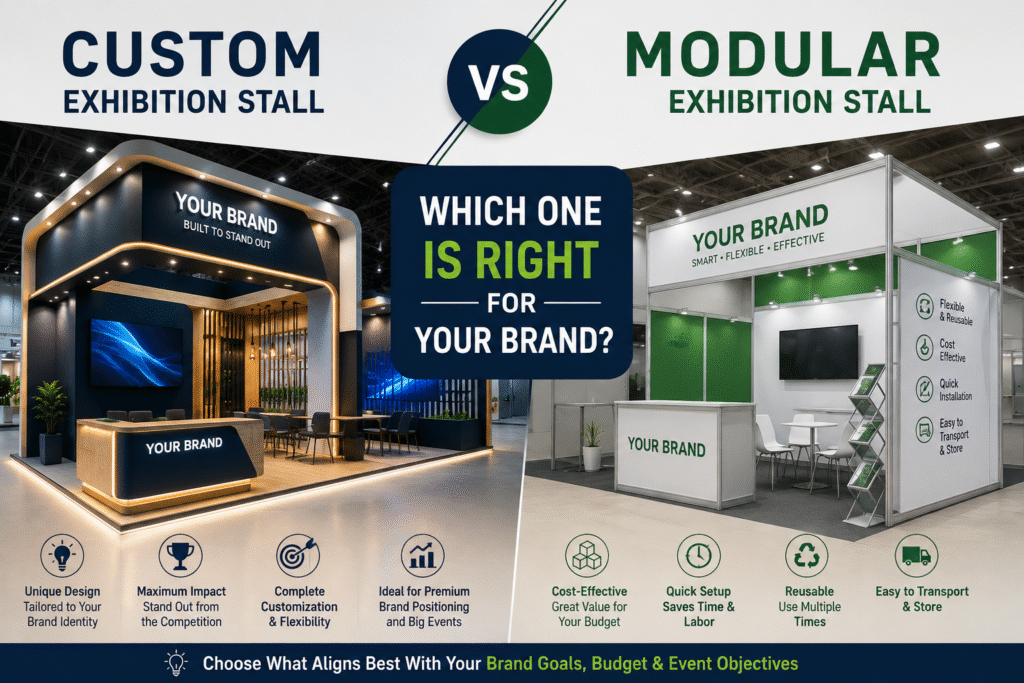
Planning to participate in an exhibition and confused between a custom and modular exhibition stall? Both options can create an impressive presence, but they serve different business requirements.
A custom exhibition stall gives you greater freedom to create a unique brand experience, while a modular exhibition stall focuses on flexibility, reusability and efficient installation.
The right choice depends on your exhibition budget, stall size, brand objectives, number of exhibitions you attend, design requirements and how frequently you plan to reuse the stall.
In this guide, we compare custom and modular exhibition stalls across design flexibility, cost, reusability, installation, branding and functionality so you can choose the right solution for your next exhibition.
A custom exhibition stall is designed and fabricated specifically around your brand, products, available space and exhibition objectives.
Instead of working primarily with standard components, the stall can be developed around a customised concept.
A custom stall can include:
The design can be adapted to the shape and size of your exhibition space and the way you want visitors to move through the stall.
For brands looking to create a distinctive visual identity, custom fabrication can provide greater design freedom.
A modular exhibition stall uses configurable components that can be assembled, rearranged and, depending on the system, reused for different exhibitions.
Instead of creating every structural element from scratch, modular systems use components designed to work together.
Typical modular solutions can include:
One of the main advantages of modular systems is flexibility. Components can potentially be reconfigured for different booth sizes and layouts.
This can make modular stalls particularly useful for companies that participate in multiple exhibitions.
| Factor | Custom Exhibition Stall | Modular Exhibition Stall |
|---|---|---|
| Design flexibility | Very high | Moderate to high |
| Brand customisation | Very high | High |
| Reusability | Depends on design | Generally high |
| Installation | Can require more work | Often quicker |
| Structural possibilities | Highly flexible | System-dependent |
| Complex designs | Excellent | More limited |
| Cost | Often higher | Often more economical |
| Reconfiguration | Depends on construction | Usually easier |
| Premium visual experience | Excellent potential | Depends on design and execution |
| Best suited for | Brand-focused projects | Repeated exhibitions |
The actual cost and performance depend on the stall size, materials, design, venue requirements, installation scope and specifications.
With custom fabrication, the design can be developed around your brand rather than forcing your brand into a predefined system.
This can be useful when you want:
Exhibitions can be crowded with competing brands.
A customised structure can help create a visual identity that is different from standard booth layouts.
The goal shouldn’t simply be to make the stall look expensive. The design should communicate your brand and make it easy for visitors to understand what your company offers.
Custom fabrication allows the design team to plan the available space around your specific requirements.
For example, a 36-square-metre stall might need:
The layout can be designed around these requirements.
If your exhibition requires special structures, product demonstrations, large graphics, suspended branding or multiple functional zones, custom fabrication can provide greater flexibility.
For companies participating in multiple exhibitions, reusable components can provide long-term value.
The same system may be adapted to different configurations, depending on the modular system and available components.
Modular systems can often be rearranged to suit different spaces.
This is particularly useful when your exhibition participation varies from one event to another.
Because the components are designed as a system, installation can often be more straightforward than constructing a completely bespoke structure.
However, installation time still depends on the design, venue regulations and overall scope.
A modular system can be an attractive option when you want a professional exhibition presence without investing in a completely bespoke structure for every event.
The actual financial advantage becomes more significant when components can be reused across multiple exhibitions.
There is no single price that applies to every exhibition stall.
The final cost can depend on:
A modular stall may offer better value for a company participating in several exhibitions because components can potentially be reused.
A custom stall may require a larger initial investment but can provide a highly tailored brand experience.
Therefore, comparing only the initial price isn’t enough. Consider the total cost and expected usage over the life of the exhibition system.
A custom exhibition stall may be the better option when:
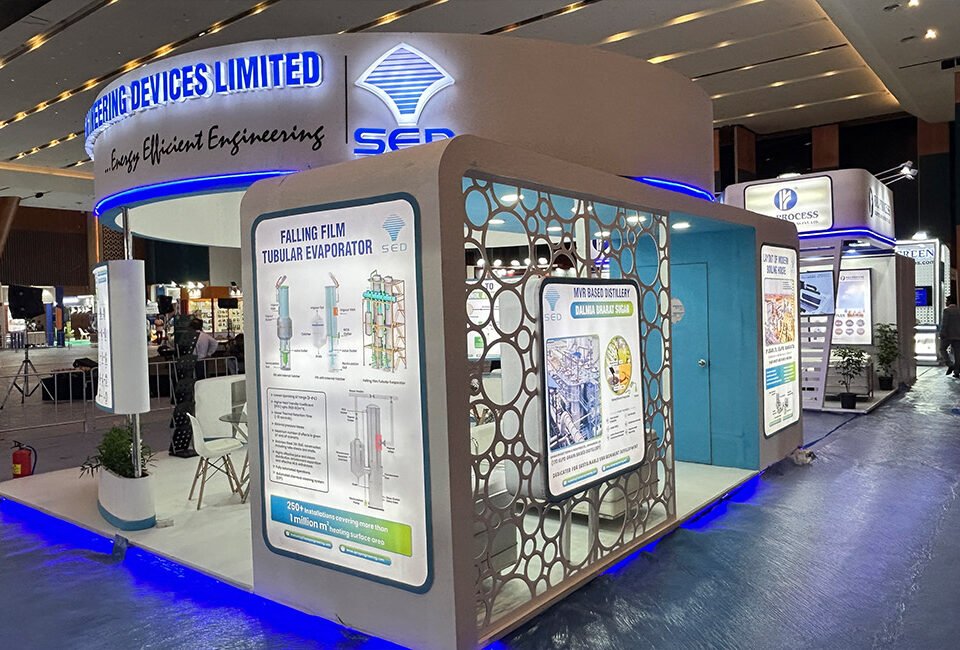
For example, an automobile, engineering or technology company demonstrating large products may benefit from a highly customised environment.
A modular exhibition stall may be suitable when:
Modular doesn’t have to mean basic. With good graphic design, lighting, furniture and branding, a modular stall can still create a professional exhibition experience.
There is also a third option: a hybrid approach.
A hybrid stall combines reusable structural elements with customised branding, displays and design elements.
For example, you could use a reusable modular structure while adding:
This can provide a balance between flexibility, branding and long-term usability.
For smaller stalls, space utilisation becomes particularly important.
You need to balance:
A modular solution can work well when simplicity and flexibility are important.
A custom solution may be preferable when you need to maximise every available square metre or create a distinctive visual concept.
Large exhibition spaces provide more opportunities for customisation.
A large stall may include:
For complex large-scale projects, custom fabrication can provide greater freedom over the overall visitor experience.
Reusability depends on the construction system and design.
Modular systems are generally designed with reuse and reconfiguration in mind.
Custom-built elements can also be reused, but their suitability depends on:
If you attend exhibitions regularly, discuss reusability with your stall fabricator before finalising the design.
Ask yourself these questions:
If you participate frequently, reusability may become an important factor.
If you need a highly distinctive environment, custom fabrication may be more suitable.
Consider not just the first exhibition but your expected usage over several events.
Product displays, meeting rooms, storage, AV and special structures may influence the decision.
If your booth dimensions vary from event to event, modular flexibility can be valuable.
There isn’t a universal winner.
Choose custom when design freedom, brand differentiation and specialised functionality are your highest priorities.
Choose modular when flexibility, reusability and efficient deployment are more important.
Consider a hybrid solution when you want the benefits of reusable components combined with a customised brand experience.
The best solution is the one that matches your exhibition strategy rather than simply choosing the cheapest option.
Whether you’re considering a custom, modular or hybrid exhibition stall, the first step is understanding your exhibition requirements.
Share details such as:
Our exhibition stall design and fabrication team can help you determine a suitable approach and develop a quotation based on your requirements.
Planning an exhibition? Get in touch with our team to discuss your stall design, fabrication and installation requirements.